Lead Stole My Words But Not My Voice

By Cooper Burkett, 18, USA

At 9 months old, I stopped saying ‘Mama.’ A construction site filled our apartment with lead dust—and my world went quiet.
My name is Cooper Burkett. I am 18 years old and I grew up in lower Manhattan. Currently, I am a first year film student at New York University in New York City. I was diagnosed with lead poisoning when I was 9 months old. The construction site below my apartment contaminated my apartment with dust filled with lead and I got sick.
The contractor sent a regular cleaning crew to our home so my parents thought the dust was gone but lead does not come out of fabrics. My parents didn’t know the rug I was crawling on or the toys I was putting in my mouth were contaminated with lead.
When I was first diagnosed at 9 months old, my level was 9. I had been speaking my first words: Mama, Dada, Hi, Bye, Ala for my sister Alice. One month later, my lead levels shot up to 19 and I lost the ability to speak. All those words I had just learned were gone. I stopped pointing. Stopped waving. Stopped responding to my name to the point that my grandfather, who is a physician, thought I might have hearing loss from the lead. My mom had my hearing tested. And my hearing was perfect. I was slipping further into my mind—like bars of lead between me and the world.
Health impacts

I have had to live with multiple side effects from my lead exposure as a baby. I have processing issues, short-term memory loss, anemia, and asthma. I also have had the worst case of PICA my pediatrician has seen in her 20-year history. I ate sheetrock off the wall, the wood off my crib, books, clothes, foam, cardboard, you name it, I ate it.
The gastro-oesophageal reflux disease (GERD) and pain in my stomach became so bad I barely ate and became “failure to thrive.” I had an ulcer when I was five. And an endoscopy biopsy revealed that I had damage to the tissue in the lining of my stomach.
The reactive asthma sent me to the emergency room and the radiologist during a particularly bad episode of pneumonia said that my lung x-rays looked the same as the kids with cystic fibrosis. I was also often angry. As a toddler, I would have violent tantrums several times a day. I would escape my apartment. Starting at 2-years-old, I would push a chair against the door and unlock the multiple old school locks and leave. My parents had to lock me in my room for my own safety. When we went on vacation, my dad had to sleep with me in a separate room and push furniture against the door so I couldn’t escape. At my grandparents’ home, I actually did escape and was found seven houses away.
I still live with a processing disorder, trouble regulating my emotions, ongoing stomach and health problems, and short-term memory loss.
From the time I was 18 months, I have received multiple services from the city: occupational therapy, special instruction, counseling and speech. I was enrolled in an Intercollaborative Team Teaching class, which is a classroom with both general and special education teachers. I’ve had multiple tutors and I was under the care of the professionals at New York University Child Study Center to help me regulate my emotions.
Advocating for change
In New York State, where I live, mandatory testing at 9 months revealed I had elevated lead levels but in many parts of the world, testing facilities are just simply not available so the true number of cases goes undetected. The PLF is trying to change that and help nations build testing facilities so the true scope of lead is known and these children can be protected from exposure to this neurotoxin.
Once these children are identified, the majority of them do not have access to the kinds of services that helped me work through the debilitating side effects of lead poisoning. We can have difficulty concentrating, low threshold for frustration, memory loss, disorderly conduct, lower IQ, processing disabilities, and multiple health problems. Lead affected kids are good kids, we just need help. And to get there, our support systems need help, too.
My mom and I started working with different organizations in the city of New York and across the state to advocate for legislation to reduce lead exposure. We saw how a personal story can move lawmakers. I will never forget sitting in a state senator’s office, and as I told my story to her, I thought she was going to cry. New York State Senator Nathalia Fernandez sat there, very quietly and when I was done she said, “How do I not know this about lead? These are children in my district. How did I not know this?” Today, she’s a champion for stronger lead laws—alongside leaders like Assemblymember Jonathan Rivera, who represents Buffalo, one of the U.S. cities hardest hit by childhood lead poisoning. Working with them has allowed me to share my story as an instrument of change to protect millions of children.
In 2023, three of the bills we lobbied for passed; including The Lead Pipe Right to Know Act (LPRTKA), which requires municipalities to inform the public on where lead pipes are located in the community. I created a 2 minutes Public Service Announcement and a 9 minute short documentary to build support and inspire action as part of the campaign to pass the Act. For Earth Day that year, I was invited to testify before The Committee for Health, Housing, and buildings in New York City. This hearing was held to discuss strengthening lead laws and determine budgetary recommendations that would reduce lead exposure. The gains we have made are significant but we still have more work to do.
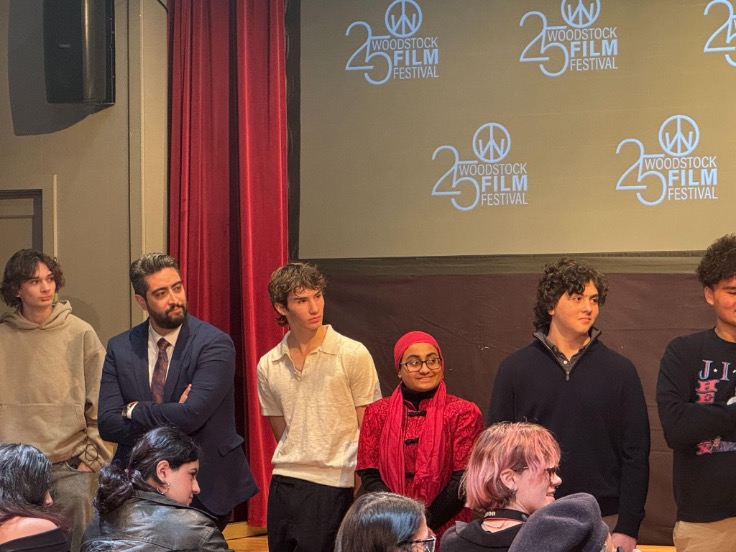
Cooper and Assemblymember Jonathan Rivera participating in a Woodstock Film Festival panel.
In 2024, in an effort to get New York State’s Lead Paint Right to Know Act passed again, my mom actually wrote and produced a podcast about our experience. This audiodocudrama, LEAD how this story ends is up to us, features Emmy Winner Merritt Wever, Alessandro Nivola, Cynthia Nixon, and me, playing myself, was an Official Selection of the 2025 Tribeca Festival and the last day of voting was on the day of our Tribeca Event. Although it hasn’t passed, we continue to advocate for its passage, because children deserve protection from lead—whether it comes from pipes, paint, or other sources.
With all that I have been through, I turned out okay. I graduated high school with high honors. I am a state champion gymnast. I have started my freshman year at New York University studying film and tv. My dream is to continue making films, including a full documentary about lead poisoning, to continue to speak up and speak out about lead, and advocate for stronger lead legislation.
Please understand, I am here because of all the people who helped get me here. I’m here because of all the help and interventions I have received throughout my life. Many children affected by lead don’t receive the support I was fortunate to have. I’m determined to ensure no child has to experience what I did.
Join me in ending childhood lead poisoning
Global estimates from Pure Earth and UNICEF suggest one in three children have elevated blood lead levels today—over 800 million kids. The Partnership for a Lead-Free Future (PLF) is working to change that by partnering with governments to strengthen laws and policies that cut exposure at the source. Lead steals a child’s potential—their possibilities, their future, who they were meant to be. We need to give caregivers and educators the training and support to help lead-affected children thrive. As a society and as communities, we must commit to eradicating lead exposure and caring for children already affected. Lead poisoning is 100% preventable—if we act and provide caregivers and educators the support and skills to deal with lead-affected children.
For more information, to see my films, or listen to the podcast, please go to endleadpoisoning.org.


