Tool 5: Clear communication to prevent and address childhood lead poisoning


This tool supports communication professionals working on lead exposure issues in LMICs. It provides an overview of different communication and advocacy strategies that can be utilized according to target audiences: policymakers, service providers, caregivers and the private sector. It includes examples of best practices and applications of communication theory in different real-world case studies from work conducted in Georgia, Bangladesh, Indonesia, Ghana and the United States.
Because people cannot see lead in their environment (e.g., in soil, water or air, or in the products they use such as spices, ceramics and religious or cultural powders), it is important to find an effective way to highlight the dangers of lead, especially in products individuals regularly use (e.g., cookware and cosmetics). In some contexts, such as South Asia, many individuals grow up using these products and have a deep cultural and spiritual connection with their use. For example, products like sindoor and kumkum, to which lead is sometimes added to brighten colours, are commonly used in Hindu practices. Community members have used many of these products since childhood and see them as an essential part of their culture. In addition, their widespread use in the community further contributes to the impression that they are harmless. Thus, it may be difficult for public health practitioners to convince community members of the risks of lead exposure from these products. These factors all point to the need for effective communication about lead exposure’s harmful effects on children.
Lead exposure communication challenges
| Challenges | Description |
| Competing priorities | Residents of LMICs typically have more immediate concerns such as availability of appropriate shelter, enough food, clean drinking water and other basic infrastructure. |
| Asymptomatic / delayed health outcomes | Lead poisoning in children is typically not immediately apparent, and/or has delayed impacts. |
| Not visible | People cannot see lead in their environment (e.g., in air, soil, water or consumer products). |
| Tradition | Many people grew up using cultural products or spices potentially containing lead without apparent health impacts and therefore believe they are harmless and concern is overblown. |
| Economic impacts | Lead may be used in industries common to LMICs, such as smelting or LAB manufacturing, and there may be a fear that regulation of lead sources may result in job loss. |
Examples of ways to approach these communication challenges include:
- Connect the potential adverse health effects to real-world consequences that are relevant to the lives of the target audience.
- Include realistic actions that can be taken, focusing on existing alternative products that are safe and still culturally appropriate.
- When speaking to policymakers and the private sector, use a data-driven strategy that shares (ideally local) data and evidence on how lead exposure directly affects the community’s health.
- For private sector engagement, provide information on alternative business practices or create a forum that fosters discussion to find a solution that works locally to help reduce childhood lead poisoning.
- Develop engaging narratives that highlight real-life stories of children and families affected by lead poisoning.
- Use powerful visuals, such as photos and videos, to illustrate the consequences of lead exposure on individuals and communities.
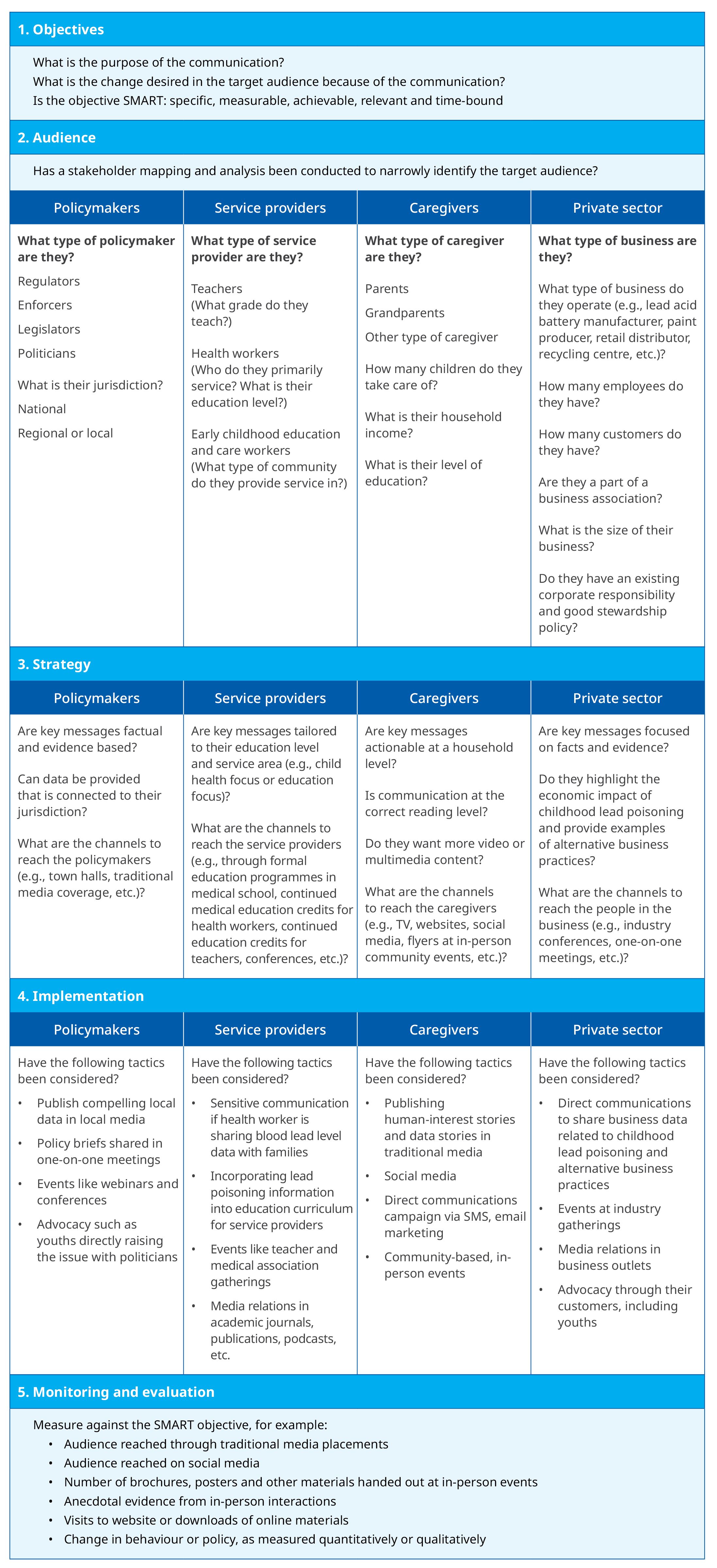
A communication strategy is a critical component in any effort to address public health issues, such as childhood lead poisoning. It serves as a roadmap for conveying key messages to target audiences, ensuring the information is understood, retained and acted upon. Core components of a communication strategy include 1) objective, 2) audience, 3) strategy, 4) implementation and 5) monitoring and evaluation.
Questions to consider when developing a communication strategy to address childhood lead poisoning
Sensitive communications
When addressing childhood lead poisoning, employing sensitive communication tactics can be crucial. Sensitive communications deal with difficult or negative information that may be received poorly by the target audience, such as informing a family that their child has high BLLs which may endanger the child’s health. For example, in many LMICs, it’s important to share this information carefully while still offering appropriate options that are available to the family and community. Sensitive communications are best delivered in-person. There are, however, written forms of sensitive communication, such as a letter from a doctor to a patient.
Here are some considerations for effectively delivering potentially distressing information:
Plan your conversation carefully. Who should deliver the message to the family: a community health worker, teacher or someone else? Outline the major points you need to convey and anticipate possible reactions.
Define what you want to achieve with the discussion.
Conduct the conversation in a private, comfortable environment to ensure confidentiality and reduce anxiety.
Encourage dialogue by asking questions that invite detailed responses. This helps you gauge understanding and address concerns.
Show empathy and understanding by actively listening to the person’s concerns and reactions
Communicate the core messages succinctly and avoid overwhelming details.
Verify that the person has understood the information throughout the conversation. Ask clarifying questions if needed.
Recognize and validate their emotional responses. This builds trust and demonstrates empathy.
Provide clear steps to protect children from lead poisoning, including recommendations to lower BLLs. These may include preventive actions like increasing the child’s calcium intake. Ensure your recommendations are culturally and contextually sensitive to the situation.